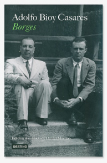
Reseña de David Gallagher [TLS, 27 de junio de 2007] y respuesta de Daniel Martino,
enviada el 3 de julio de 2007.
(a) GALLAGHER, David, “Borges finds his Boswell”. TLS, nº 5439, 27 junio de 2007 (la edición en papel está fechada el 29):
Adolfo Bioy Casares
BORGES
Edited by Daniel Martino
1.663 pp.
Adolfo Bioy Casares had his first conversation with Jorge Luis Borges in 1931 or 1932, when Bioy was about eighteen and Borges was thirty-two. From then on they enjoyed an extraordinarily intense literary friendship which lasted until Borges’s death in 1986. In 1947 Bioy started to write a diary, in which he recorded the often daily conversations that make up this gargantuan book. The diary clearly covered many other topics, and they are tantalizingly referred to by Daniel Martino, the editor of Borges, in a short, unilluminating preface. Martino says that “Bioy’s diaries open up a vast universe where his notes on his conversations with Borges coexist with his writings on everyday life and his frequent examinations of matters of conduct”. Martino seems to have had exclusive access to this material, but he does not tell us where the rest of it is, which is a pity because Bioy is a considerable writer in his own right, even if many critics still see him first and foremost as Borges’s friend, and collaborator in numerous stories and satires which they jointly wrote under the pseudonyms of H. Bustos Domecq and B. Suárez Lynch.
Whatever else he recorded in his diary, Bioy does seem consciously to have cast himself in the role of Borges’s Boswell. Bioy in his jottings often refers to Dr Johnson, one of his and Borges’s favourite writers (on a visit to England, Borges, a rabid Anglophile, tells a surprised audience that Johnson is more English than Shakespeare); and the two friends sometimes wonder whether Johnson knew that Boswell was writing down everything he said. Borges – in Bioy’s entry for May 18, 1960 – thinks Johnson did, and that he wrote little in his last years because he felt Boswell was doing the job for him. Borges adds that Johnson probably did not bother to ask Boswell to show him what he was writing or try to correct it, because to do so would have been inconsistent with his innate “sloth, nonchalance and generosity of spirit”. Bioy then asks himself whether Borges knows he is writing this diary, “whether he would be curious to read and correct it, if the fact that he has recently been writing so little is due not only to bad sight and sloth, but also to knowledge of this book”. There is no evidence that Bioy ever told Borges about it. Maybe Borges’s remarks on Johnson were enough to put Bioy’s conscience at rest. Which is just as well, because the book reveals intimate details about Borges, including his gauche relations with women, which Bioy, a renowned womanizer, meticulously avoids when it comes to himself. Or is Martino’s editing to blame here? Maybe Bioy’s own intimacies are revealed in those “examinations of matters of conduct”, which Martino is probably sitting on somewhere? Those of us who knew Bioy remember him as a generous, gentlemanly man. It is hard to imagine Bioy being so unfair in his diary as to reveal the secrets of his friend without revealing his own.
Borges goes to dinner at Bioy’s flat in Buenos Aires several times a week. The diaries laboriously record these events, and their lively post-prandial conversations held late into the night. Sometimes for days on end they will write a Bustos Domecq short story or satire, with Bioy trying to restrain his friend’s tendency to cram the narrative with abstruse jokes and baroque embellishments. At other times – more and more, as Borges grows blinder over the years – Bioy will read to Borges, and they will comment on the text. Their comments are usually scathing. These two passionate lovers of literature find very little to like in what they read. Flaubert has an awkward, “bureaucratic” style which stifles the reader’s interest. Shelley has a “disagreeable facility for complicated verse”, Rabelais is “abominable”, T. S. Eliot is “beneath contempt”, which is strange considering the similarity between Eliot’s and Borges’s conceptions of writing as a form of creative reading that modifies the texts that precede it.
Given Borges’s aversion to long novels, which he rarely read in full, it is not surprising that he should think Tolstoy tedious. “I think it is best to read only the war sections”, he says of War and Peace. And then he adds, sarcastically: “only then you miss out on the romance”. Borges, unlike Bioy, tends in general to believe love not to be a suitable subject for literature. On Baudelaire, Borges complains that it is “ridiculous to fill literature with cushions and furniture and show evil in a positive light. Baudelaire helps one gauge whether a person understands anything at all about poetry, whether he is an imbecile or not: anyone who admires Baudelaire is an imbecile”.
“Maybe every writer, read with care, reveals his imbecility. We ourselves do”, concedes Borges at another dinner. But Silvina Ocampo, Bioy’s wife, also a fine poet and writer of short stories, whom Borges tends to ignore despite being her almost daily guest, offers another explanation for his tendency to find everything awful. “With every day that passes he is less and less inclined to like work that is not his own”, she says. To be fair, Borges does like some writers (Bioy likes many more, but in the face of Borges’s overbearing personality, he keeps many of his opinions to himself). Borges almost unreservedly admires Kipling, Stevenson and Chesterton. He also likes Kafka, Rubén Darío, Antonio Machado, St John of the Cross and Verlaine. On Cervantes, Lope de Vega, Gracián, Calderón, Góngora and Quevedo, he is changeable, but always interesting – he is deeply immersed in the Spanish classics.
One feature of the literary discussions is that both Borges and Bioy have prodigious memories – one remembers Borges’s story “Funes, the Memorious”, about a Uruguayan farmhand who simply could not forget anything at all. Funes “knew by heart the forms of the southern clouds at dawn on 30 April 1882, and could compare them in his memory with the mottled streaks on a book in Spanish binding he had only seen once”. The two friends are able to recite verse endlessly to each other. One of their tests of whether a poem is good is whether one can memorize it easily. Bioy says there must be a flaw in Browning’s “Memorabilia”, because he cannot remember the last strophe. Borges agrees, although characteristically he proceeds to recite it. They both intensely dislike Neruda’s poetry and one of the reasons they give is that it does not stick in the mind. Borges suggests that Neruda probably does not even remember his own poems and would probably not notice if a reader missed a line or two.
Borges’s best literary insights occur when, instead of being judgemental, he makes one of those dazzling, irreverent associations that are a central feature of his fictions. He suggests to Bioy that Kafka and Jesus have a similar way of apprehending the world, through images and parables, and then quotes his atheist father as having said that, in that respect, Jesus was very like the gauchos of the pampas. He suggests that the two most arresting themes in literature are the fall of Troy and Christ’s Passion. However, he later compares the death of Jesus unfavourably with the death of Socrates. “Socrates was a gentleman and Christ a politician looking for compassion.” Borges is also good on other kinds of literary comparison. American realism, he says, “shows violent, brutal, vulgar people without irony, as though the author were one of them”. French realism, on the other hand, is always ironic. “Zola appears always to be saying ‘that is what man is like’”, as from a distance. Borges quotes Sir Thomas Browne as saying that a gentleman is always unassuming and unobtrusive, that he tries to avoid being a nuisance. By contrast, he quotes the Argentinian writer José Luis Lanuza as saying that a gentleman is someone who deliberately imposes his presence, is a nuisance, and is constantly on the watch lest somebody slight him. Borges says that that is the Spanish view of a gentleman, one which he considers absurd. “For who is not resigned to being at times slighted and defeated?”
What else do the two friends do during their almost nightly vigils? Sometimes they listen to tangos. Bioy says that tangos stimulate Borges, who of course knows all the lines. When in a good mood, they play literary games. Asked to write a blurb for a book they haven’t read, they comply by quoting at length from a critic they invent. They compile an anthology of texts on heaven and hell to which they give false attributions. They choose a Muslim text on the remission of sins and initially decide to attribute it to a Communist they dislike intensely. “Rafael Alberti”, suggests Borges breezily. In the end they plump for J. M. de Rapalda, the author of a Catholic Catechism. They recite deliberately bad lines of invented verse to each other. “The trees standing in line like memories”, ventures Borges. As they leave Bioy’s flat at night, Bioy suggests “The light remained trapped in the lift, like a bird in a cage”. Borges says he can do worse: “we slipped into the darkness of the night like messages dropped into a letter-box”.
One of Borges’s happiest veins is as a satirist of pompous, self-important Argentinians. That vein pervades all his work. It is easy to forget that Borges’s cult story, “El Aleph”, is not only about a point in space, implausibly hidden in a Buenos Aires basement, that contains every other point in the universe, but also about the ludicrous epic poet Carlos Argentino Daneri, who owns the basement, and who tries to describe what he sees there in hopelessly inadequate, bombastic verse. On one level the story is a reflection on what happens if the greatest of literary themes falls into the hands of an idiot, in particular an Argentinian literary idiot. Bioy is also a consummate satirist in his stories and novels. It is against that satirical vein they both share that one might most charitably judge the inordinate amount of gossip they indulge in. Through the thirty-nine years of conversations recorded in Borges, the two men gossip about tedious fellow writers, beautiful but silly society ladies, fatuous politicians, and their own literary agents, publishers and translators – no one they know is spared. This aspect of the diaries has caused a great deal of dismay in Argentina, not least because some of the victims are still alive, and others have large surviving families. People are surprised that Borges and Bioy should have been so consistently mean about people.
But they are often very funny, especially when describing tea parties at Victoria Ocampo’s house in the suburb of San Isidro. Victoria, Silvina’s sister, is the literary grande dame of Buenos Aires. They see her as a ridiculous snob, avidly courting any celebrity who comes to Buenos Aires: Bioy calls her the city’s “celebrity impresario”. He suggests that she only discovered that Borges was a great writer when he was awarded the Prix Formentor in 1961. Borges agrees, adding that for Victoria, “esse est percipi; percipi by other people”. Later she is to write a book on Borges claiming that she was among the first to recognize his genius. Borges and Bioy punish her by often refusing her invitations. Sometimes they cave in, but soon regret it because, as Borges says, Victoria “confuses hospitality with house arrest” – they get their own back by being obnoxious, criticizing the tea (a local brand that tastes of medicine – Victoria is apparently too mean to buy imported tea) and the sandwiches (“the bread tastes of DDT”), and by leaving far too early.
Yet Borges is also nasty about people who are kind and enthusiastic about him. He was awarded an honorary doctorate by Oxford in 1971, and I, as a lecturer in Latin American Literature, was one of his hosts there. We gave a dinner for him to which we invited Robert Lowell, who felt he had become a close friend of Borges after a trip to Buenos Aires in 1962 and a visit by Borges to Harvard, where Lowell had presented him. We also invited Iris Murdoch. Borges purported not to know who Lowell and Murdoch were. So to avoid offending them, we introduced Iris Murdoch as Mrs John Bayley, and Lowell as “the American poet”. On which Borges started reciting Walt Whitman, as though to say he only recognized the category but not the individual. On reading Bioy’s diary, I now discover that Borges not only knew perfectly well who Lowell was, but that he had developed an intense dislike for him by 1962. It turns out that Lowell had committed the gaffe of being rude in front of Borges’s mother. In her flat Lowell had asked who the most beautiful woman in Buenos Aires was, “to go to bed with her”. He had also made the mistake of praising Fidel Castro, and of taking off his jacket and shoes, and sitting on the floor. On returning from Oxford, Borges reports to Bioy that Lowell is a “complete idiot”. Yet Lowell seems to have enjoyed and indeed multiplied the meeting. In a letter to Elizabeth Hardwick, he says, “one of the most exciting things here has been Borges’s visit. I have had two nights more or less alone with him, talking about Tennyson, James and Kipling, and almost wept when he talked ‘without pity’ to an audience about his blindness”. As for Iris Murdoch, Borges not only reveals that he knows who she is. He quotes her as saying to him “I am half a bolshie, you know”. “A half-wit”, says Borges to Bioy.
Fortunately, Borges’s great works rise way above the tetchiness of their author. But no great insights into them will be found in Adolfo Bioy Casares’s Borges. They wrote a lot together, but they do not seem to have discussed each other’s individual works much. Bioy is always taken by surprise by the appearance of a new Borges story or poem in a newspaper or magazine – Borges had told him nothing about it. Borges’s reluctance to discuss his work was indeed legendary. It was part of his deep rejection of any interpretation that attempted to reduce his stories to some specific set of ideas. When asked what the message of a story was, he would say, “I am not a messenger”. He does not reject criticism. He accepts that a critic may attempt to reveal a meaning of which he as an author is unaware. But the story for him remains always “merely a dream, what I dreamt”. Borges and Bioy admire Kafka, to whom both owe a lot, because he refrained from explaining his mysteries. “Kafka does not need to explain: his mystery is the mystery of the world and of life.” Borges was to take Kafka’s suppression of any explanation to the realm of the detective story, where the detective never solves the crime – or, worse, becomes its victim. Borges turned the genre into a potent metaphor of human frailty and ignorance.
One Borges that emerges in Bioy’s book is the persona developed in numerous, often outrageous interviews, particularly in the latter years – Borges turned the interview into a whole new literary genre, in which he would appear as a sort of caricature of himself. This is a Borges who is politically very incorrect on all fronts. He hates the Left, is enthusiastic about local military coups, supports US military interventions, extols capital punishment, looks down on anyone whose origin is African, and is rabidly misogynistic. So is Bioy. They decide to go to a cock fight together in the country, but without women, on the grounds that they never allow one to concentrate, are always demanding something, and prevent one from being creative. “Nothing more concrete, more bourgeois, more limited than a woman”, says Borges. The main problem, add the buddies to each other, on several occasions, is that women just have no capacity for abstraction. For that reason they cannot even understand morals, or any other kind of principle. Borges’s unsavoury views ensured he was not given the Nobel Prize.
Borges is a curious book because, despite so much talk, much that most ordinary mortals consider really important is left unsaid between the two friends. Maybe they have little of that “female” capacity to discuss concrete issues. But then why do they spend so much time gossiping about Buenos Aires literary politics, and plotting to rig elections for SADE, the Argentinian writers’ union? It is mostly personal feelings that they avoid dealing with. Practically every night at dinner in the Bioy household there is one other guest, Manuel Peyrou, a writer whom Borges, curiously, judges to be not entirely awful. Bioy (as edited by Martino) does not really tell us much of what Peyrou has to say, save that, for no particular reason, he is rabidly anti-Italian. But one day Bioy discovers that Peyrou has recently got married. Borges’s mother tells him. She found it out from Bioy’s maid, who overheard Peyrou telling Silvina. Peyrou clearly thought that something so banal as marriage was not a topic he could broach with his self-absorbed, unsentimental male friends.
Borges does pour out his soul now and then to Bioy and Silvina, particularly when he falls in love with María Esther Vásquez in 1963 and they both visit the Bioys in Mar del Plata. Also when Borges marries Elsa Astete in 1967, after living for sixty-seven years with his mother. Borges’s affairs (which, Bioy insinuates, may be largely unconsummated) turn him into a figure of farce, all the more so because of his clumsy manners, awkward physique and growing blindness. The women he falls for are usually not much more than half his age, and he cuts an absurd figure alongside them. Bioy sometimes seems to gloat on these occasions. If we had access to his entire diary, his depictions of a ridiculous, decrepit Borges chasing after young girls would probably have appeared in a wider context, one which contained self-mocking descriptions of Bioy’s own love affairs. Bioy was a charmingly self-deprecating man who enjoyed laughing at himself. I would be surprised if he had not done so in his diaries.
He missed Borges in the seven last months when Bioy’s final girlfriend, María Kodama, had him living in Geneva. On Saturday, June 14, 1986, Bioy is in the street, looking in a kiosk for J. W. Dunne’s An Experiment with Time – he has just given his own copy to his son Fabián, and he wants to buy another for himself – when a man with the face of a bird tells him that Borges has died. Bioy walks on to another kiosk a few blocks away, taking his first steps “in a world without Borges”. Despite not seeing him much recently, Bioy had never lost the habit of saying to himself, “I must tell him this. He’s going to like this. Or he is going to think that idiotic”. He remarks that finding Dunne’s book is a happy omen, because he is meeting Fabián for the first time. It seems characteristic (at least through these diaries as edited by Martino) that Bioy has never mentioned Fabián before. Bioy had recently been told that he had a twenty-three-year-old son by Fabián’s mother. Fabián had just developed a chronic illness, and the mother needed Bioy’s help because she could not afford the treatment.
This book will seem far too long to readers who are not Borges or Bioy scholars. But it is often entertaining. Daniel Martino must be credited for the fact that it appeared at all. But he should have published all of Bioy’s diaries. If to do so was commercially impossible, he should have explained at greater length what they contained, and where they are now, so that scholars can freely consult them, and maybe try their own luck at publishing them. And it is incredible that a book of this length has no index. It has at the end a list of people who appear in it, but no page references – a major shortcoming for a book that few will read from beginning to end but which many readers will want to consult.
|
Respuesta de Daniel Martino, enviada el 3 de julio:
The Times Literary Supplement,
Times House,
1 Pennington Street,
London E98 1BS
MIT BORGES ZU TISCH
Ref.: David GALLAGHER´s Review of Adolfo BIOY CASARES, Borges. Edited by Daniel MARTINO. Buenos Aires (sic): Destino, 2006 (TLS, June 29th).
Sir, -In the wilderness of Adolfo Bioy Casares criticism, David Gallagher’s contribution will be of lasting value. Working as curator for the 1990 Cervantes Prize, I was eager, and glad, to include his “The novels and short stories of ABC” (1975) in the companion volume, a necessarily slim critical anthology on that year’s recipient. It was with expectation that I found his name in your pages (June 28) as the reviewer of Borges. I hate to say that expectations went by, and some trepidation came in. My opinion is that the reviewer got wrong the nature of the book, an installment in the process of publication of Bioy Casares private papers, which began well in the writer’s lifetime with the miscellany ABC de Adolfo Bioy Casares that I edited in 1989.
Bioy appointed me editor of his papers in 1994. He saw in book form the epistolary travelogue En viaje (1996) and the commonplace book De jardines ajenos (1997), and only his untimely death in March 1999 prevented him from seeing between two covers the journal-sans-dates Descanso de caminantes (2001) and Borges (2006). As it is said in the Editorial Note to the latter, Bioy read and corrected the manuscript twice before publication. The correspondencebetween Bioy Casares and Borges, a slender volume since they met for dinner many times a week in half a century of friendship, is the next planned publication. Needless to say, they were not careless letter-writers.
As a diarist, Bioy was as prolific as a fiction writer. Even more. Some critics already prophesy, at their own risk, that this strain of his writings will outlast all the others. The sheer bulk of his output is impressive, and enticing. As the readers know from Descanso de caminantes, this diary is 20,000 pages long. Within this mass, as it is said in the Editorial Note, Borges was, since its inception, a separate project of Bioy’s.
The publication of the `personal´ diaries will follow. Once they are published, as was stated by a document Bioy signed in 1994, the diaries will be deposited at a higher learning institution. Mr Gallagher has nothing to worry about. These diaries will show Bioy as the gentleman he was. A rather ferocious gentleman, I have to say: I will not make my tiger a cat to please anybody, as James Boswell put it.
On occasion, due to his surprise at what he perceives in Borges as Bioy´s self-effacement, Mr Gallagher enhances this stance. Some words of Bioy’s, concerning the supposedly bourgeois character of women (see Borges, p. 465), are attributed to Borges. Men exchange women as well as words, Claude Lévi-Strauss dixit, and thus Mr Gallagher labels María Kodama, Borges´ wife, as “Bioy´s final girlfriend”. In Gallagher’s economics, words go to Borges, women to Bioy.
Mr Gallagher is quite right about the Index. The publishing house (Destino is in Barcelona, not Buenos Aires as the review states) thought it a ballast in a first printing. The Analytical Index is duly completed; it has 90,000 words. It will be published soon.
DANIEL MARTINO |